
Composition and Classification of Insulating Rods
Insulating rods are a type of composite material that combines structural support and electrical insulation functions. They are commonly used in power equipment such as transformers and switchgear, as well as some high-end industrial equipment, for supporting, isolating, or fixing related components. Different applications require different electrical properties, mechanical strength, heat resistance, and processing requirements for insulating rods. This article systematically introduces the technical characteristics and selection methods of insulating rods from two aspects: material composition and classification.
Basic Composition of Insulating Rods
Insulating rods are composed of reinforcing materials and a resin matrix through a specific process. Their overall performance depends on the combination and ratio of these two materials.
1. Reinforcing Materials
Reinforcing materials mainly provide mechanical strength and structural stability. Common types include:
Glass fiber: High strength, good rigidity, and dimensional stability. It is currently the most commonly used reinforcing material.
Polyester fiber/synthetic fiber: Good toughness and processing performance. It is suitable for medium to low load applications.
Composite fiber structure: This type of reinforcing material improves impact resistance and structural reliability by mixing multiple fibers.
2.Resin Matrix
The resin matrix affects the heat resistance, electrical properties, and environmental adaptability of insulating rods. The main types include:
Epoxy resin: Good insulation performance and high mechanical strength. It is mostly used in medium and high voltage electrical equipment.
Phenolic resin: Good heat resistance and aging resistance. It is suitable for structural components in high-temperature environments.
Unsaturated polyester resin: It has a lower cost and is commonly used in general industrial insulation applications.
Classification of Insulating Rods
Based on material composition and performance characteristics, insulating rods can be classified as follows:
1. Classification by Reinforcing Material and Resin Combination
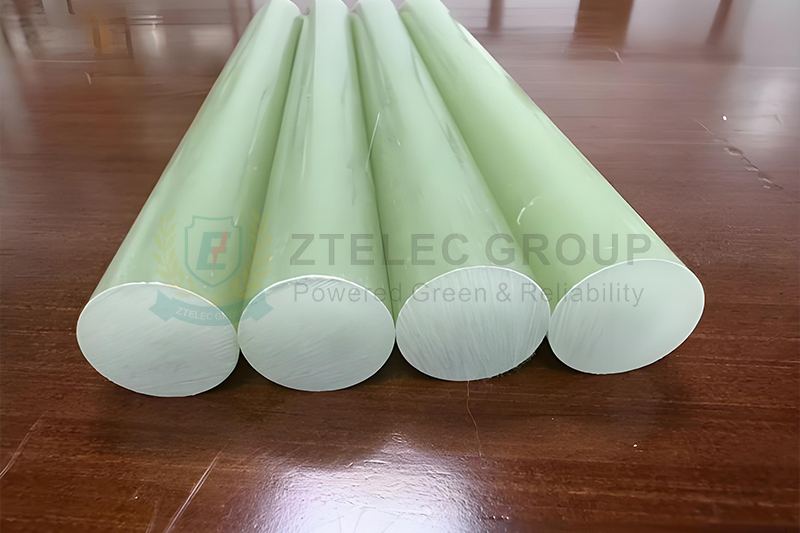
Epoxy Rods: The rods offer good electrical insulation and mechanical properties. And they are primarily used for transformer supports, tie rods, and insulating connectors.
Phenolic Rods: The rods has high temperature resistance and strong mechanical load bearing capacity. And they are suitable for internal structural components of switchgear.
Composite Fiber Insulating Rods: The rods has outstanding fatigue resistance and impact resistance. They are used in applications with special requirements.
2. Classification by Performance Characteristics
High Insulation Type: Used for insulation support in medium and high voltage electrical equipment.
High Strength Type: Used for structural parts subjected to large tensile, compressive, or bending forces.
High Temperature Resistant Type: Suitable for industrial environments with long-term high temperatures or frequent temperature changes.
Considerations for Selecting Insulating Rods
Electrical Performance: Operating voltage, dielectric constant, loss, arc resistance, and creepage distance, etc.
Environmental Adaptability: Operating temperature, humidity, pollution level, chemical corrosion resistance, and UV resistance.
Mechanical properties: Tensile, flexural, and compressive strength, impact and fatigue resistance, dimensional stability and creep resistance.
Safety and compliance: Flame retardant rating (e.g., UL94, IEC 60695), environmental requirements (e.g., RoHS, REACH), and relevant industry standards (e.g., IEC, ASTM, GB).
Main Application Scenarios of Insulating Rods
1. Power Transmission and Distribution
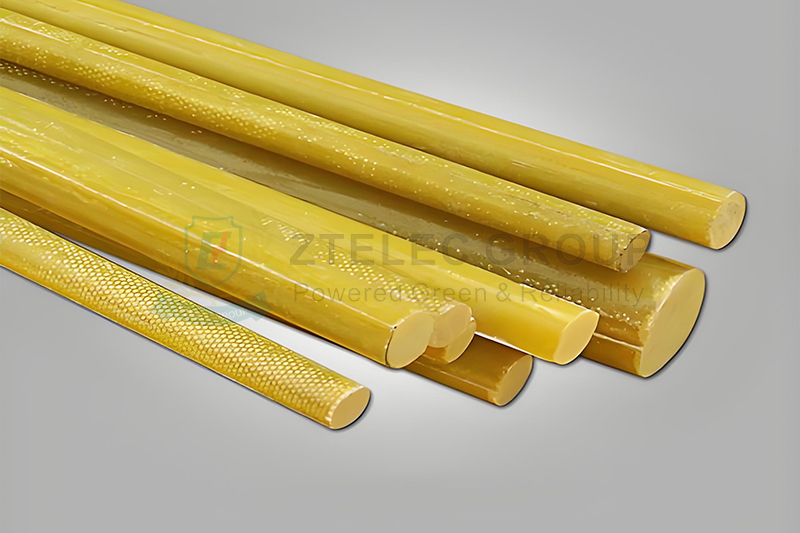
High-voltage switchgear: Epoxy resin composite rods are commonly used, providing both insulation and support.
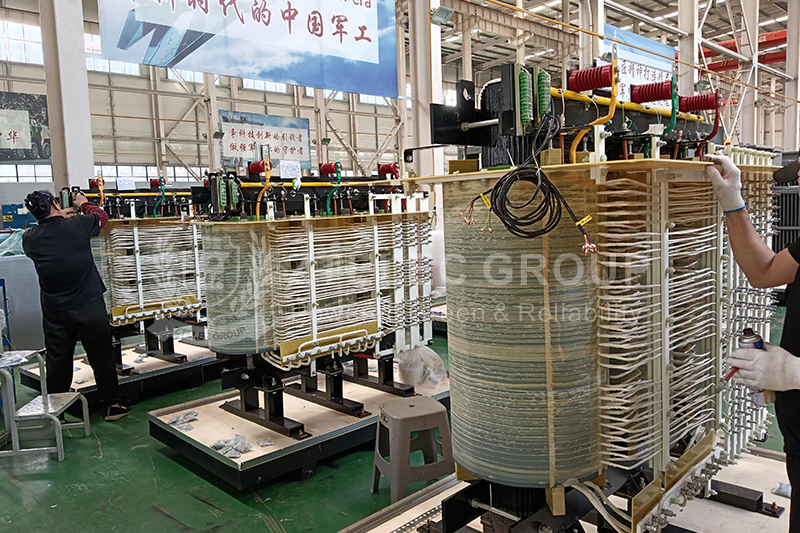
Transformer equipment: Laminated paperboard or epoxy composite insulating rods are frequently used for winding support and component isolation.
Cable accessories: Silicone rubber or epoxy resin composite insulating rods are commonly used to meet the insulation requirements of terminals and joints.
2. Electronics and Electrical Engineering
PCB support and isolation: Polyimide or PTFE insulating rods are commonly used, offering high temperature resistance and low dielectric loss.
3. Motor Insulation Components
Mica or epoxy composite insulating rods are commonly used for motor slot wedges and phase-to-phase insulation.
As power equipment develops towards higher voltage, higher reliability, and longer lifespan, the material composition and classification of insulating rods have become a crucial foundation for insulation system design. Understanding the different material combinations and performance characteristics helps in accurate selection, improving the safety and economy of electrical systems.
If you have any purchasing needs for insulating rods, please contact us. As a professional manufacturer, we can provide customized products in all sizes and specifications.
- more+releated article
- 2026-01-04Common Power Transformer Faults: Causes, Solut
- 2025-12-312026 New Year Holiday Notice
- 2025-12-31Operation, Maintenance, and Service Life Manag
- 2025-12-30How to Select a 100 kVA–500 kVA Distribution
- 2025-12-29The Impact of NHN NMN Composite Insulation on
- 2025-12-26Practical Application of GPO-3 Insulation Boar
- 2025-12-2510kV Transformer Replacement Timeline: Install
- 2025-12-25Low Smoke EN45545 GPO3 UPGM203 Laminated Board
- 2025-12-24Merry Christmas — ZTelecgroup Christmas Cele
- 2025-12-24How to Select a Suitable 50kVA–500kVA Distri
- ELECTRICAL INSULATION BOARD MATERIALS
- ELECTRICAL INSULATION MATERIALS
- POWER TRANSFORMER
- ENAMELED WIRE
- SWITCHGEAR


- transformer overheatingtransformer overloadtransformer short circuitinsulation failure transformertransformer maintenancepower transformer faults11168kVA oil-immersed transformercommercial power transformer500 kVA distribution transformer100 kVA distribution transformerindustrial transformer selectionSingle-Phase Dry-Type Transformer10kV transformer replacementdry type transformer50kVA distribution transformertransformer selection guide500kVA distribution transformer20kV 2500kVA Dry-Type Transformermedium voltage power transformer66kV power transformer66kV transformer applicationsindustrial power transformertransformer manufacturing process upgradeoil-immersed transformer reliabilitypower transformer service life