
Transformer Manufacturing Production Line Process Flow: Core Cutting, Winding, Assembly, and Testing
In transformer manufacturing, product performance is determined long before the unit is energized for the first time. It is largely defined by how consistently the production process is executed. Even small deviations during manufacturing can later appear as higher losses, abnormal noise, or insulation problems in service.
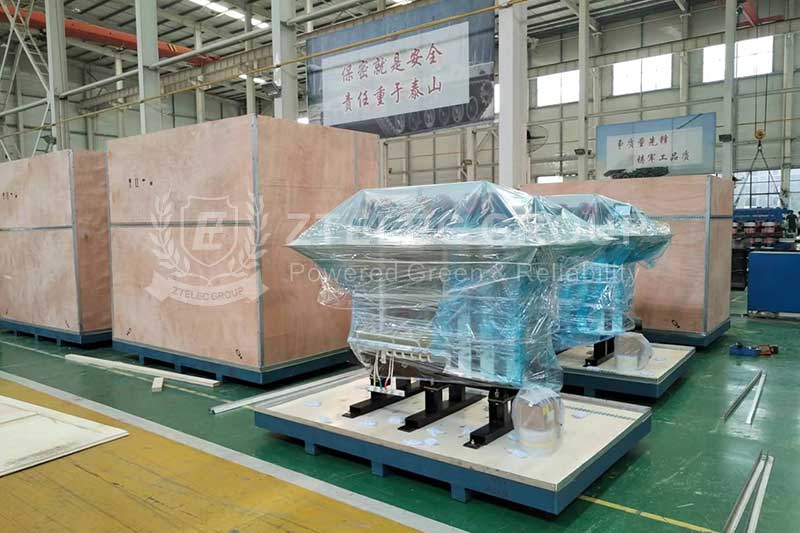
A typical transformer manufacturing production line includes four main stages: core cutting, winding, assembly, and final testing. These stages are common across power, distribution, dry-type, and oil-immersed transformers, although the specific parameters may vary by design and standard. The following sections describe each stage from a practical engineering standpoint.
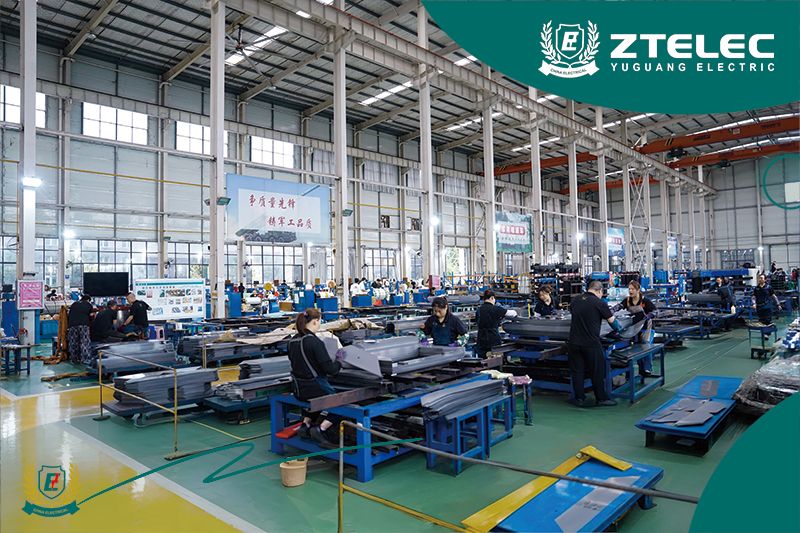
Core Cutting
The core is the magnetic backbone of the transformer. Its quality directly affects no-load loss, excitation current, and audible noise. In practice, many performance issues can be traced back to insufficient control during core processing.
Cold-rolled grain-oriented silicon steel is normally used because of its low loss and stable magnetic properties. Sheets are cut using CNC or laser cutting equipment to maintain tight dimensional tolerances, typically within ±0.1 mm. Accuracy at this stage is important, as misaligned joints increase magnetic reluctance and local heating.
After cutting, edge burrs are removed and insulation coatings are applied to the lamination surfaces. A stepped lap lamination structure is widely adopted, as it improves flux distribution at the joints and helps reduce both losses and operating noise. Burr height must be carefully controlled, as excessive burrs can lead to interlaminar short circuits during long-term operation.
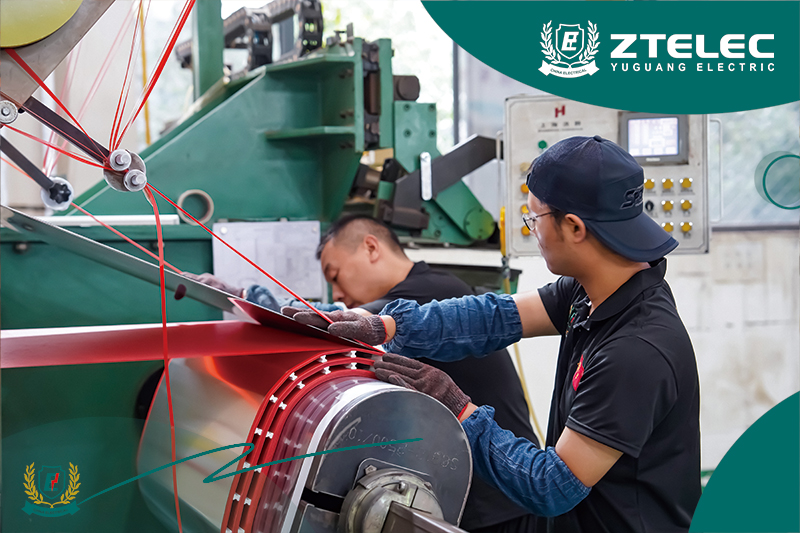
Winding Process
The winding forms the electrical circuit of the transformer and is one of the most sensitive manufacturing steps. Winding quality has a direct influence on load loss, temperature rise, and short-circuit withstand capability.
Low-voltage windings are commonly made using flat copper conductors or copper foil. This structure provides good current distribution and mechanical strength. High-voltage windings usually use round copper wire or multi-layer insulated conductors, with CNC winding machines controlling turn count, layer spacing, and winding tension.
Insulation materials are placed between winding layers in accordance with IEC or IEEE requirements. Vacuum pressure impregnation is then applied to improve dielectric strength and mechanical bonding. Lead connections are completed using inert gas shielded welding, which ensures low contact resistance and reduces the risk of joint failure during operation.
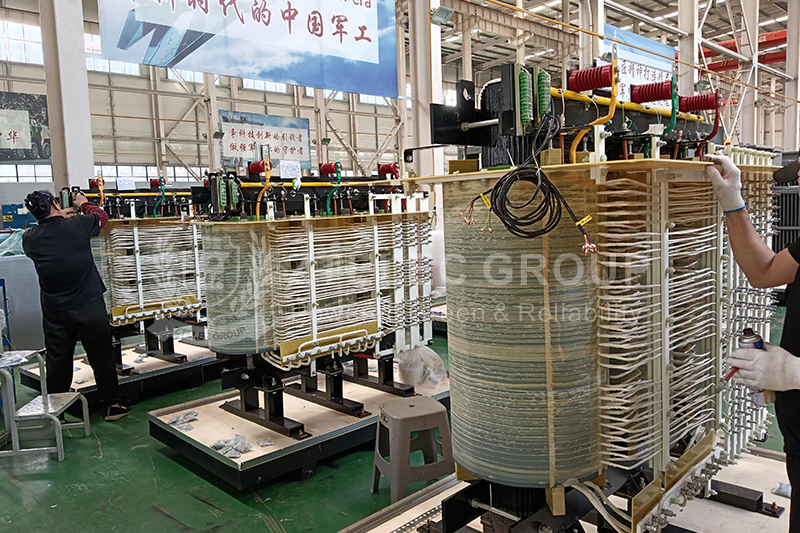
Assembly Process
During assembly, individual components are combined into a complete transformer unit. At this stage, dimensional accuracy and alignment are critical, as errors are difficult to correct once the unit is fully assembled.
The wound coils are installed onto the core limbs, with attention paid to concentricity between high-voltage and low-voltage windings. Insulation barriers, spacers, and support structures are installed to maintain the required electrical clearances and mechanical stability.
For oil-immersed transformers, radiators, oil piping, and sealing components are installed, followed by vacuum oil filling to remove moisture and trapped air. For dry-type transformers, cooling fans and temperature monitoring systems are integrated to ensure effective air cooling. Outdoor transformers typically use sealed enclosures or welded tanks to achieve protection ratings such as IP55.
Finished Product Testing
Before shipment, each transformer is subjected to a series of electrical and mechanical tests. These tests are intended to verify that the unit meets design specifications and applicable standards, including IEC, IEEE, and GB.
Routine tests include winding resistance measurement, voltage ratio verification, insulation resistance testing, dielectric loss measurement, and no-load and load loss testing. Partial discharge testing and power frequency withstand voltage testing are performed to confirm insulation integrity.
When required by the project, type tests such as temperature rise testing, lightning impulse testing, and short-circuit withstand capability testing are carried out to validate performance under severe operating conditions.
Why a Complete Production Line Matters
A manufacturer with a complete transformer manufacturing production line can maintain better consistency across different production batches. Standardized equipment and procedures reduce variability and make quality easier to control.
Modern production lines increasingly incorporate digital monitoring, machine vision, and data analysis tools. These technologies allow manufacturers to identify process deviations early and continuously improve efficiency while reducing material waste and energy consumption.
From an engineering perspective, selecting a transformer manufacturer with proven process control and comprehensive testing capability is essential for ensuring stable, long-term operation of power system projects.
- more+releated article
- 2026-01-13Rising Resin Costs Put Pressure on the Semicon
- 2026-01-13Transformer Manufacturing Production Line Proc
- 2026-01-12A Specialized Manufacturer of Oil-Immersed Tra
- 2026-01-09Application Analysis of 11168kVA Oil-Immersed
- 2026-01-08Epoxy Pre-impregnated DMD vs. DMD: Key Differe
- 2026-01-08Why Oil Type Transformers Are Still a Core Com
- 2026-01-08Insulation Paper Production Cost and Profit An
- 2026-01-08How do the processing characteristics of DMD p
- 2026-01-08150KVA Three-Phase Dry-Type Isolation Transfor
- 2026-01-08Specific Applications of Glass Fiber Wound Tub
- ELECTRICAL INSULATION BOARD MATERIALS
- ELECTRICAL INSULATION MATERIALS
- POWER TRANSFORMER
- ENAMELED WIRE
- SWITCHGEAR


- transformer manufacturing production lineVehicle Drive SystemsInsulation materialsutility transformer supplierpower transformer factoryoil-immersed transformer manufacturerindustrial oil immersed transformerSMC Sheetssubstation transformer application11168kVA oil immersed transformeroil immersed power transformerdmdinsulation paperDMD PrepregThree-Phase Dry-Type Isolation TransformerGlass Fiber Wound TubeG10 Glass Fiber Filament Winding TubeSMC Insulation BoardsInsulation Paper NMNsubstation transformertransformer working principlePower transformertransformer structurevoltage conversion transformeroil conservator tank